
Branch 2 general household pest control
Residential Pest Control for Single-Family Homes
You want the ants out of the kitchen, the webs off the eaves, and a straight answer about what it takes to keep them gone. Residential pest control is nearly all Apex Pest Control does: about 99 percent of the work is single-family homes, and the company has been doing it in the Sacramento area since July 1, 1978.
Monday to Friday, 8 a.m. to 5 p.m. Estimates come from your home’s square footage and what you are seeing.
SourcesWritten from the interview with Jeff Alexander, Apex’s verified business facts, and the references linked at the end of the page.Last updated September 2026.
This page is the honest scope statement. It lists what Apex treats under its Branch 2 general household pest control registration, what it assesses case by case, what it refers to another specialist, and what happens on the first visit and every visit after. If a pest is not on this page, ask; the office would rather say no than take a job it should not.
Scope, stated plainly
General Pest Control Services We Provide
California defines Branch 2 as general household pest control, excluding fumigation with poisonous or lethal gases. Branch 3 covers wood-destroying organisms, which Apex does not hold.
Pests covered under our Branch 2 license
Ants, spiders, wasps and yellow jackets, American, Oriental and German cockroaches, fleas, ticks, silverfish, earwigs, carpenter bees, pantry pests, boxelder bugs, beetles and crickets. Each has its own page with identification and what the visit involves.
Assessed case by case
Rodents: bait stations for rats and mice and recommendations on trees, gaps and pet food, with major work referred. Honey bees: a beekeeper first, treatment only as a last resort. Wasps on two-story roofs: treated from the ground, no ladders. Indoor German cockroaches: full preparation of the kitchen required.
Pests we do not treat
Termites and other wood-destroying organisms are Branch 3 work and are referred to a termite company. Bed bugs are referred to a heat-treatment company. Rodent exclusion, cleanup and repairs, birds, squirrels, raccoons, possums, moles and voles go to a trapper or wildlife specialist. Flying insects such as flies and mosquitoes are not controlled.
How it works
How Our Home Pest Control Service Works
Every first visit runs in the same order, and the order is the point: the technician has to understand the problem before treating it.
The initial interior and exterior visit
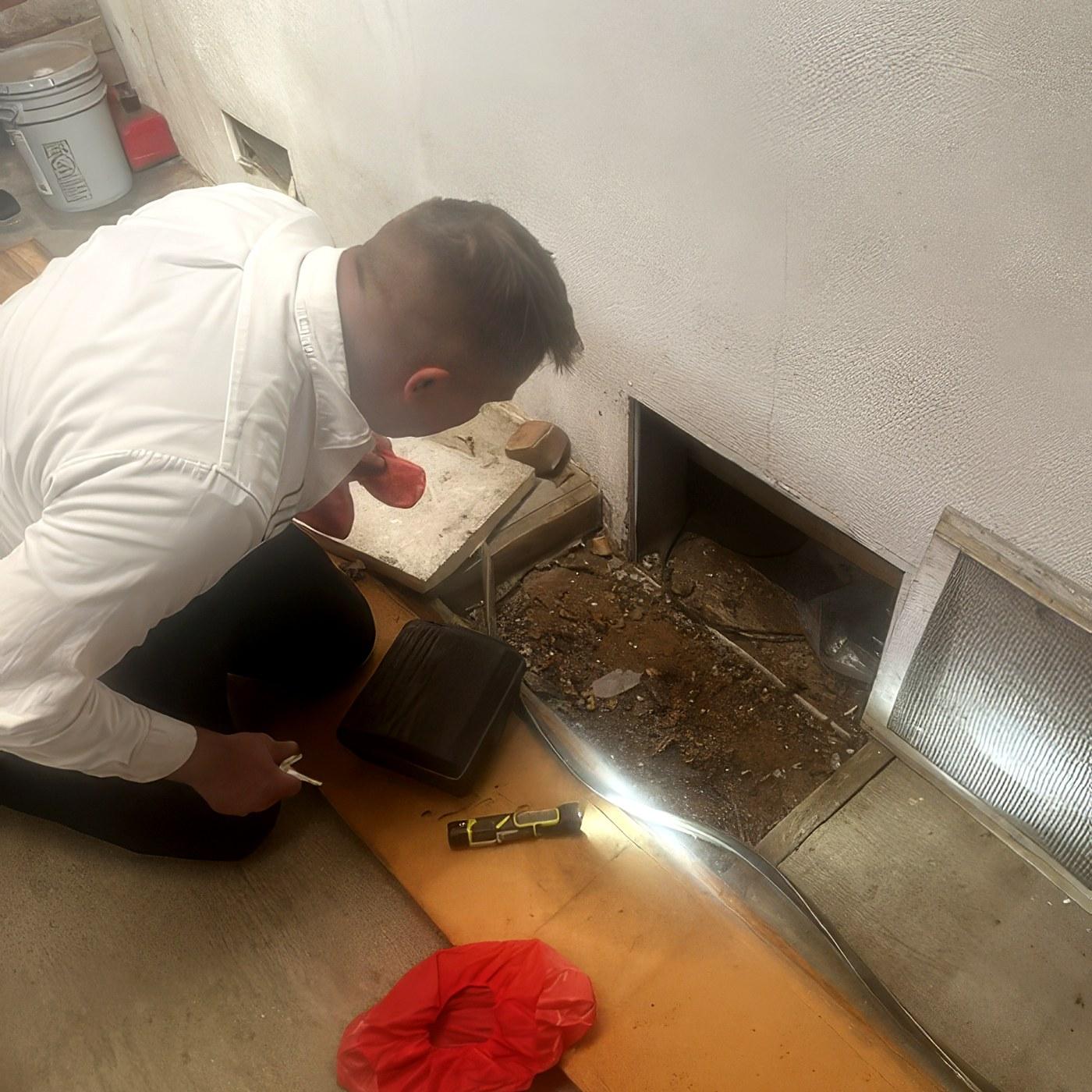
Interview: why you called, what you have seen and where. Then the technician tours the house and walks the property, identifies the pest and the conditions behind it, treats the interior where the activity is with low-odor products, and treats the exterior barrier.
The exterior barrier
Foundation, garage, around windows and doorways, under the first-floor eaves, fence lines and the yard areas around the home. That barrier is what regular visits replenish.
Web removal and the recommendations
Spider webs come down from eaves, sliders, porches and the garage on every visit. The visit ends with recommendations you can act on.
What Regular Visits Include
On the on-going maintenance program, regular visits are bi-monthly. The technician re-treats the exterior barrier to reinforce it and removes webs. You do not need to be home; if a gate is locked or a dog is out, the technician leaves a note and the missed area is rescheduled at no extra cost. At most homes the inside is retreated less than once a year, because the barrier is doing its job and interior pests between visits are covered by the guarantee.
On rainy or saturated days the technician uses a granular product around the base of the home that withstands up to four inches of rain, and liquid goes on protected areas. The visit does not get skipped because of weather.
Sacramento seasons
Pest Pressure Through the Year
The main bug season in the Sacramento Valley runs April to October: ants, spiders, fleas and the big outdoor roaches. From November to February, when temperatures drop below 40, it gets quiet and ants become the main problem. Rodents appear year round.
Extremes drive the calls. Several days of triple-digit heat push ants into bathrooms and kitchens looking for water; the first heavy winter rain floods their nests and pushes them inside the same way. Summers here are warm and dry, and more than half the year's rain falls November through February, which shapes when each pest shows up.
How Apex Chooses and Applies Products
Apex selects the method for the pest, the location and the label requirements, then explains what to expect. The technician gives you the label-specific re-entry, drying and cleaning guidance for what was applied at your home; treated areas stay off-limits until dry, and drying varies with the weather, so there is no single blanket waiting period.
Technicians work in the personal protective equipment California requires for treatment: long sleeves or coveralls, long trousers, safety glasses and gloves. No masks and no moon suits, because the products and placements do not call for them. County agricultural commissioner staff make unannounced spot checks, and Apex welcomes them.
Our Guarantee for Maintenance Customers
Continuing maintenance customers in good standing get return visits at no additional charge for any contracted pest problem between regular service dates, and the technician keeps returning until the problem is solved to complete satisfaction. Troublesome pest issues may require a supervisor's input. The company's goal is to reach the home within 24 hours of a guarantee call, and it is stated as a goal, not a promise.
Why homeowners choose Apex
Licensed and Family Owned Since 1978
Apex was founded by Bill Brandon, a retired Air Force veteran, on July 1, 1978, and has been family owned and operated ever since. Bill's son-in-law Jeff Alexander, the president, and Bill's son Brent Brandon, the secretary, have managed it together for about thirty years, and Bill's grandson Jared Alexander joined the team thirteen years ago. Jeff came in 1988 after work in environmental consulting and industrial hygiene, and holds degrees in botany and zoology and a master's degree in biology. The company holds Structural Pest Control Board registration No. 2770 (Branch 2). Its three named operators, president Jeffrey P. Alexander (No. 8484), secretary Brent Brandon (No. 12138) and Jared F. Alexander (No. 14137), carry licenses you can verify with the Board.
Apex has been a BBB Accredited Business since 1984 with an A+ rating, a California Pest Management Association member since 1999, and was named Best Pest Control in the 2026 Best of Times awards. About one in three new customers comes by referral. Apex has supported Make-A-Wish for more than 25 years, donating more than $100,000.
Who Apex Is Built For
The particular homeowner who expects the property to look visibly serviced afterward, with the webs gone and the notes left. The prevention-minded household that wants fewer indoor treatments and a consistent technician. The family that calls because a parent or a neighbor has used Apex for years. And the new Sacramento-area homeowner who has moved into a development or a previously vacant house and wants to know what is normal here and what a proper first visit includes. The answer to all four is the same visit, done in the same order, with the same honesty about what it can and cannot fix.
How Residential Pest Control Is Priced
Estimates are given over the phone from the home's square footage and what you are seeing. The estimate is confirmed at the home, because the interview and the walk-around often turn up more than the caller described. The $90.00 new-homeowner discount is applied to every quote the office gives, and is not valid with other offers. Office hours are Monday to Friday, 8 a.m. to 5 p.m.
Other Household Pests We Treat
Earwigs, carpenter bees and pantry pests are on the treated list too. They are covered under the same maintenance program, and the technician identifies which one you have before treating.
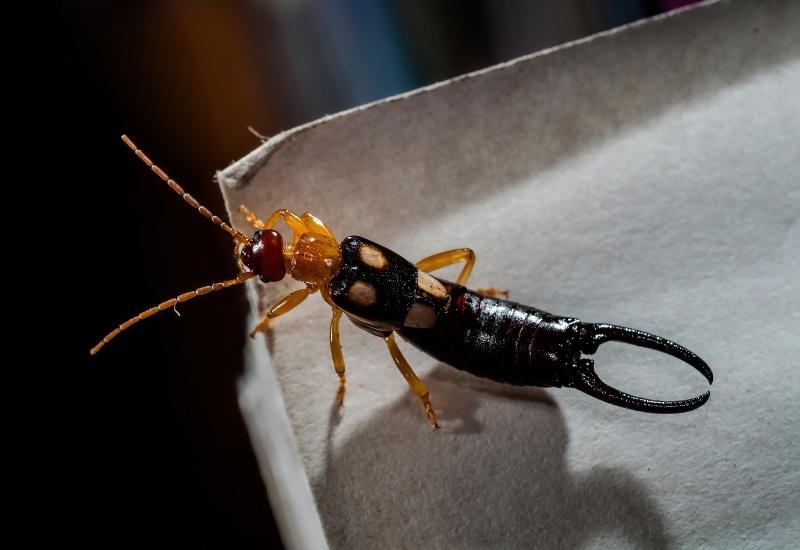
Earwig
Beyond being unwanted in your home, earwigs also present several risks, including being pinched by their pinchers, their fast reproduction rate, and when the weather is wet and cold, they want to get inside your house even more than before. Ultimately, earwigs aren’t dangerous. They will pinch you, but this pinch rarely even breaks skin. They also don’t spread any diseases to humans.
Earwigs aren’t dangerous to humans, but they still pose a set of challenges. They’re an obnoxious and hazardous garden pest, as they eat dying plant matter and smaller beneficial insects. In addition, earwigs come in large numbers and rapidly reproduce. This means if you see one earwig in your house, there are most likely many more hiding in dark spaces.
Carpenter Bee
Carpenter bees are large, solitary bees known for drilling perfectly round holes into wood to create nesting galleries. Unlike honeybees, which live in colonies, carpenter bees tend to nest individually, though several bees may nest in the same area. While they are essential pollinators, their burrowing behavior can cause significant structural damage over time, making pest control for carpenter bees a necessity for homeowners in Sacramento, CA.
Carpenter bee pest control involves identifying, treating, and preventing infestations caused by these wood-boring insects. Effective pest control for carpenter bees requires a multi-faceted approach, including direct treatment of nesting sites, preventative measures to deter future infestations, and repairing damage to wooden structures.
Pantry Pest
Many pantry pest infestations begin at food processing plants. This is where food products can become infested with eggs or larvae. These foods, and their subsequent guests, then enter businesses or homes. In other cases, pantry pests will find their way into businesses or homes through the spaces around doors and windows.
If you notice one or two pantry pests, you can try early elimination by continuing with this protocol on your own. You will need a vacuum, caulk, a wet rag, soap, water, and personal protective equipment (mask, gloves, eyewear).
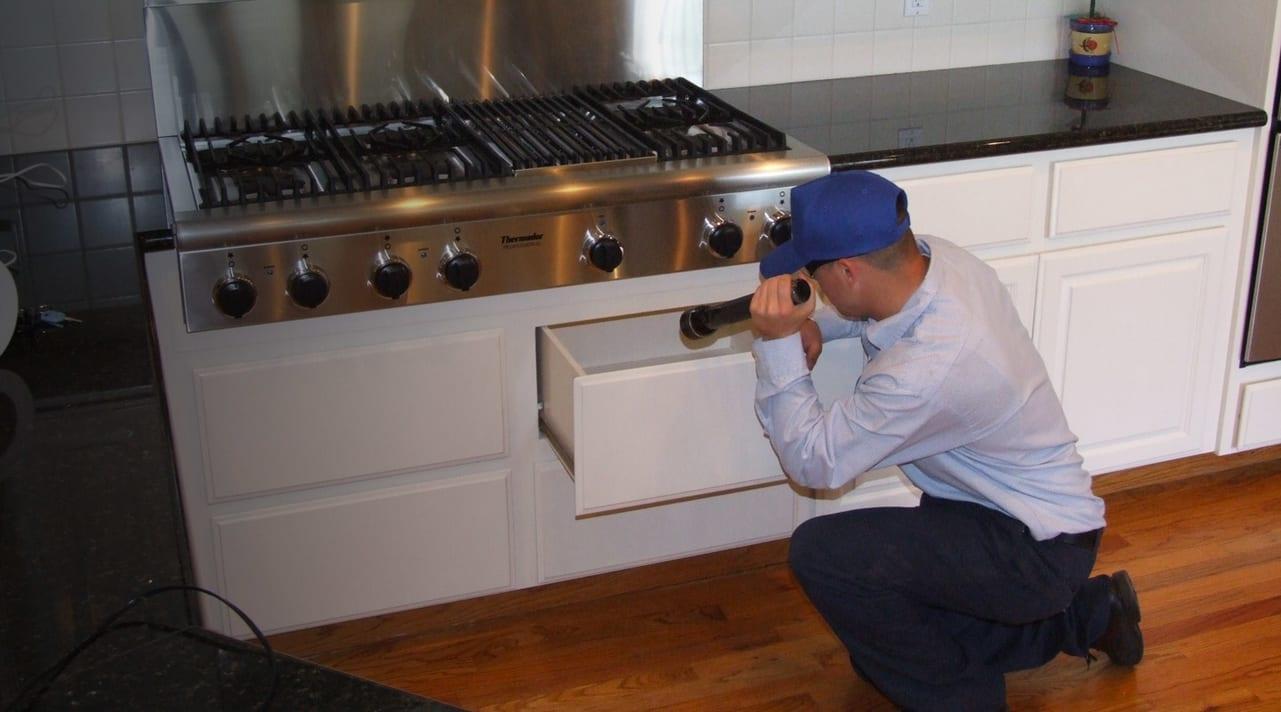
Apex technician kneeling with a flashlight to inspect under a kitchen cabinet toe kick.
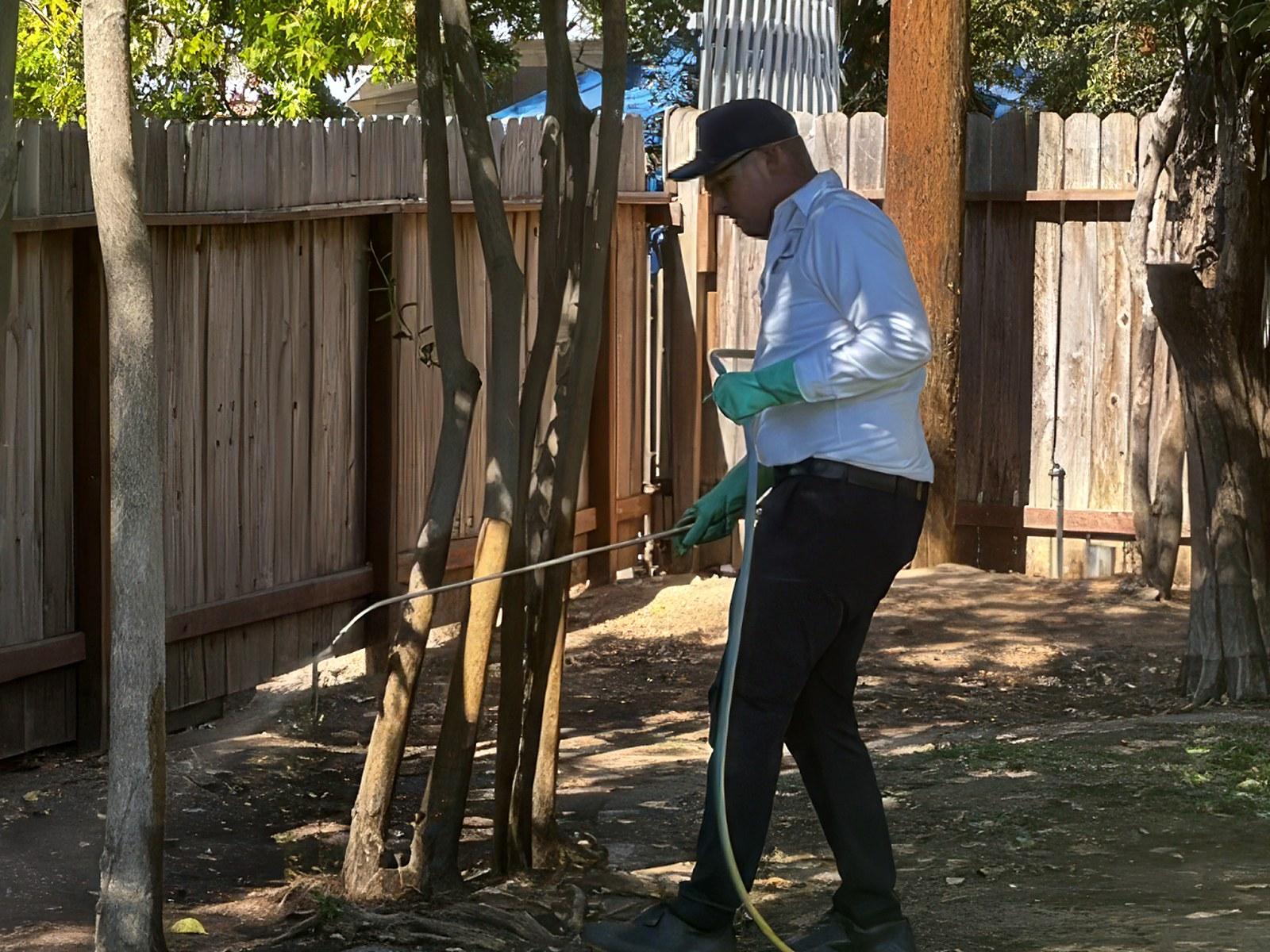
Apex technician treating along the base of a back fence under bare trees.
What we treat, and when we refer
Is your pest on the list?
Branch 2 general household pests. Find yours in one of the three columns; tap anything in the middle column for the full rule.
We treat
On the maintenance program
- Ants
- Spiders
- Wasps and yellow jackets
- CockroachesAmerican, Oriental, German
- Fleas
- Ticks
- Silverfish
- Earwigs
- Carpenter bees
- Pantry pests
- Boxelder bugs
- Beetles
- Crickets
Not sure what you have?
Describe it to the office at (916) 362-9294; the technician confirms it on the first visit.
The estimate is confirmed at the home, after the interview and the walk-around.
Scope, in detail
What Apex looks at first, and what it refers
Everything else on the treated list (ants, spiders, wasps and yellow jackets, American cockroaches, Oriental cockroaches, German cockroaches, fleas, ticks, silverfish, earwigs, carpenter bees, pantry pests, boxelder bugs, beetles, crickets) is covered by the maintenance program. These are the cases with a condition attached.
| Pest or job | Apex’s answer | Why |
|---|---|---|
| Rodents | Assessed for fit | Bait stations and recommendations (trim trees off the roof, close gaps, remove outdoor pet food). Heavy infestations needing exclusion, cleanup, and drywall repair are referred. |
| Honey bees | Assessed for fit | Beekeepers first from Apex's referral list; spring swarms resting in trees are left alone; treatment only as a last resort when bees are in the structure and no beekeeper will take them. |
| Wasps on roofs | Assessed for fit | No ladders on two-story homes for wasps. On one-story tile roofs, ridge caps can be treated, but Spanish tile roofs have countless gaps; expectations are set with the customer. |
| Indoor German cockroaches | Assessed for fit | Requires full preparation (clean, empty kitchen cabinets) and customer cooperation. |
| Termites and other wood-destroying organisms | Referred | Branch 3 work; Apex is not licensed to identify or treat. |
| Bed bugs | Referred | Referred to a heat-treatment company; not covered by the guarantee. |
| Major rodent exclusion, cleanup, and repairs | Referred | Outside Apex's specialty. |
| Birds (pigeon exclusion) | Referred | Specialty exclusion work. |
| Squirrels, raccoons, possums, moles | Referred | Trapper or wildlife specialist. |
| Voles | Referred | Agricultural pest outside Apex's license scope. |
| Flies and mosquitoes | Referred | Flying insects are not controlled. |
Real reviews, unedited
What customers noticed
“We have been with Apex for 17 years. From that first phone call to inquire about their services until now we have been very happy with the service.”
“We have been a customer of APEX since purchasing the family home from my mother's estate, the past 10 years. My mother was a customer of their's for many years prior to that. They are always willing to go the extra-mile for us, whether it's bugs, rats, or other creatures. The administrative staff is wonderful to work with over the phone, and we love our onsite technician. Great job APEX Pest Control!!! Keep doing what you're doing.”
“We have been customers of Apex for over a year and have been very happy. Mikey, our serviceman, is professional and very thorough.”
Reviews are quoted exactly as written. More reviews
Licensed, accredited, verifiable
Three named Branch 2 operators, one company registration, and a record you can look up yourself.
Branch 2, Structural Pest Control Board, issued 1995, clear status.
Verify: Company registration on the official recordPresident. Botany and zoology degrees, master's in biology, former industrial hygienist.
Verify: Jeff Alexander on the official recordSecretary, and a Branch 2 operator licensed since 2011.
Verify: Brent Brandon on the official recordBranch 2 operator, and the third generation of the family on the route.
BBB accredited since 1984. CPMA member since 1999. 2026 Best of Times, Best Pest Control.
Verify: Accreditation on the official recordCalifornia defines Branch 2 as general household pest control excluding fumigation with poisonous or lethal gases. Branch 3 covers wood-destroying organisms. Technicians renew their licenses every three years with required continuing education.
Can you do your own pest control?
Some of it, yes, and Apex says so. Integrated pest management means the homeowner's housekeeping, sanitation and sealing reduce the product a professional needs: trim limbs off the house, close gaps, rake litter and clippings from the foundation, do not leave pet food outside, keep outdoor lights off when not in use.
What a store spray cannot do is reach the colony. Repellent products kill most of the insects they touch and scatter the survivors; non-repellent products spread through a colony by transfer. Choosing the right one for the pest, the location and the label, and never mixing them, is the practical science Apex brings.
What is done on the initial visit?
An interview and an inspection, then interior and exterior treatment focused on the problem areas, corrective recommendations, the exterior barrier and spider web removal. Many of the products used are extremely low odor. The visit ends with recommendations you can act on.
How often will my home be serviced?
Apex runs bi-monthly maintenance programs. Regular visits re-treat the exterior barrier and remove webs. At most homes the inside is retreated less than once a year, and interior pests between visits are covered by the guarantee for customers in good standing.
Do I need to be home for regular exterior treatments?
No. If a locked gate or a loose dog keeps the technician from an area, you get a note and a free reschedule for the missed area. The first visit includes the interior, so someone should be home for that one.
Do you treat termites or bed bugs?
No. Termites are Branch 3 work and are referred to a termite company. Bed bugs are referred to a heat-treatment company and are not covered by the guarantee. Apex holds a Branch 2 general household pest license and stays inside it.
Is a one-time treatment enough?
Sometimes. Fleas after a pet is gone, or a move-out, are the clearest one-time cases. For spiders a one-time visit is usually a bandage because the webs return. The office will tell you honestly which situation you are in before you book.
Do you offer after-hours or weekend service?
No. Office hours are Monday to Friday, 8 a.m. to 5 p.m. When the office is closed, the after-hours information line at (916) 392-2068 explains what to do; the main number for scheduling is (916) 362-9294.
How do I verify Apex's license?
Look up company registration No. 2770 and operator licenses No. 8484 (Jeffrey P. Alexander) and No. 12138 (Brent Brandon) with the California Structural Pest Control Board. Technicians renew every three years with required continuing education.
Related on this site
Next step
Start with a phone estimate.
Tell the office your home's square footage and what you have been seeing. The estimate is confirmed at the home, because the interview and the walk-around often turn up more than the caller described.
Monday to Friday, 8 a.m. to 5 p.m.